How many types of helpdesk requests are there?
There are five common types of helpdesk request: incidents, service requests, change requests, problems and information requests. Each one is logged as a ticket, but they need different handling: an incident is fixed as fast as possible, while a service request is fulfilled to an agreed, predictable timescale.
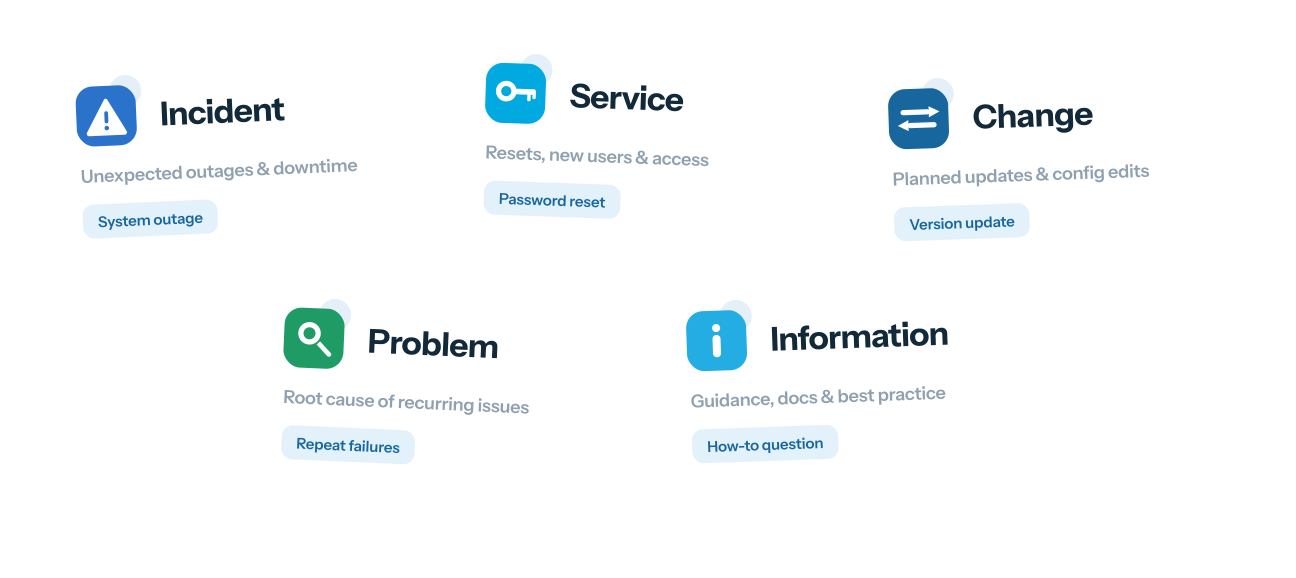
The five types at a glance
| Type | What it is | Examples | Typical priority |
|---|---|---|---|
| Incident | Something that worked has broken or degraded | Email is down, an application crashes, the VPN will not connect | High to urgent - restore service first |
| Service request | A routine, expected request for something new | Password reset, new starter account, software installation, access to a shared folder | Low to medium - a predictable fulfilment time |
| Change request | A modification to a live system that needs approval first | A firewall rule change, a software upgrade, a new integration | Planned - scheduled after sign-off |
| Problem | The underlying cause behind repeated incidents | The same printer error reported ten times in a month | Investigated in the background |
| Information request | A question rather than a fault or a task | How do I book a meeting room? Where is the expenses policy? | Low - often answered by the knowledge base |
What is a service request?
A service request is a formal request from a user for something routine and pre-approved: access, equipment, information or a standard change such as a password reset. Nothing is broken. That is the difference from an incident, and it is why service requests usually get a lower priority and a fixed fulfilment target rather than an urgent response.
What is the difference between an incident and a service request?
An incident means something is not working as it should; a service request means someone needs something new. “My laptop will not start” is an incident. “I need a laptop for a new starter on Monday” is a service request. Keeping them apart stops routine requests from crowding out outages, and lets you report on each separately.
What is request management?
Request management is the process of receiving, approving, fulfilling and closing service requests in a consistent way. In practice it means a clear way to ask (an email address or a portal form), a category for each request type, an approval step where sign-off is needed, a target time for fulfilment, and a record of who did what.
How do you handle each type in Raiseaticket?
- Label the type - create a category for each type under Settings > Category, so every ticket is labelled and reports can be split by type. The free plan includes up to 10 categories.
- Set the urgency - give incidents a higher priority and a shorter SLA target than routine service requests.
- Add sign-off - use approvals on requests that need a manager to agree before work starts. Full change management is a Premium add-on.
- Find the problem - record a root cause when tickets are resolved, so repeated incidents point to the underlying problem.
- Answer once - publish answers to common information requests in the knowledge base, so people find them without raising a ticket.
All of this is on the free plan for 5 agents and 500 tickets a month. See also what is a ticket? and IT help desk software.
